About Our Workshop
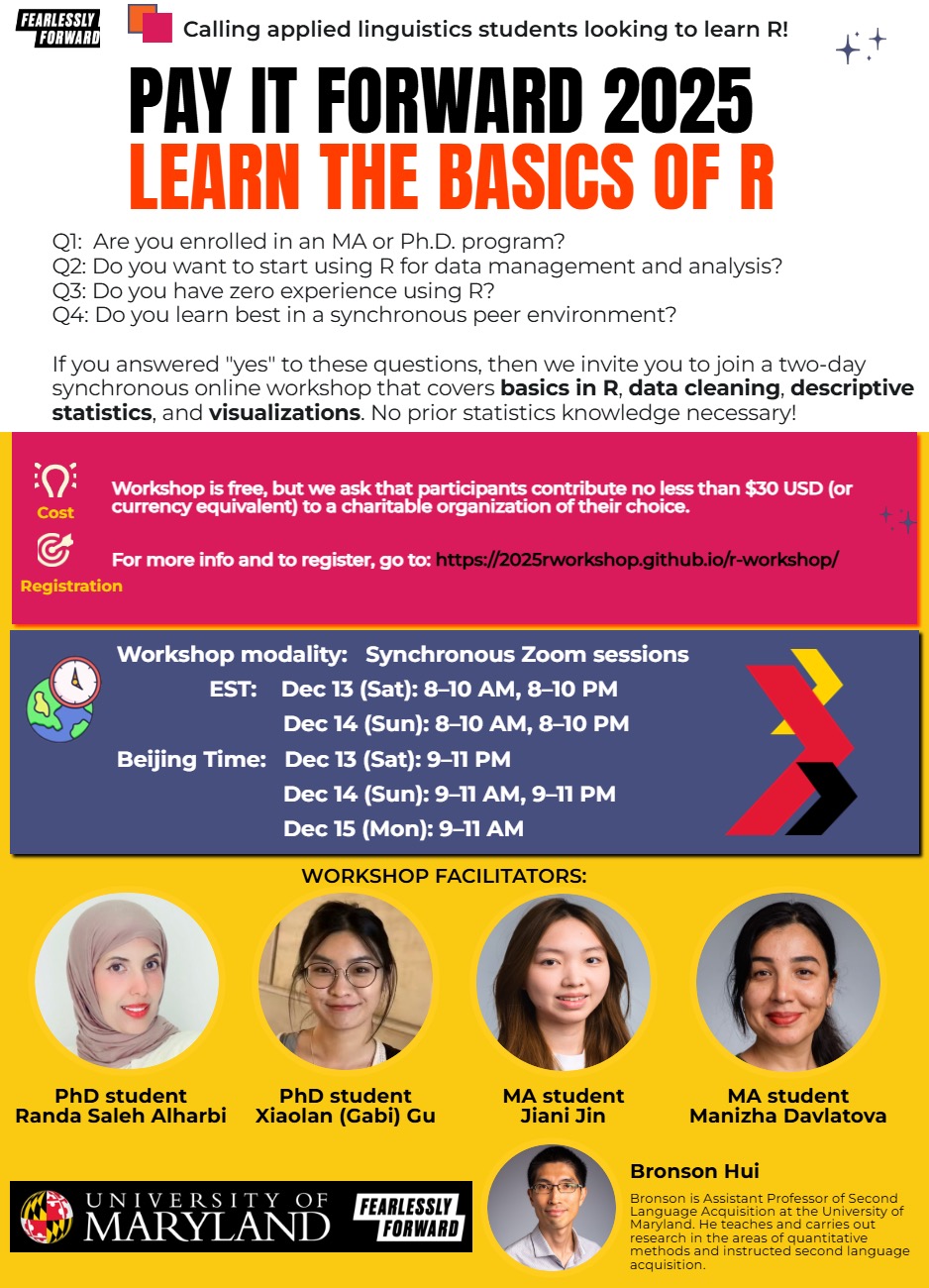
Welcome to our 2025 R workshop designed for applied linguistics researchers and students!
This event aims to share knowledge, build community, and empower researchers to use R in their own work.
Goals:
By the end of this workshop, you will:
• Use R Studio to develop and execute code that can analyze your data
• Use R to assist you in cleaning your data for analysis
• Use R to render publishable quality visualizations of your data
• Utilize the help features in R to troubleshoot your R code
• Draw on open source and publicly available resources to troubleshoot R code to meet your data analysis needs
Dates and Time:
EST:
Dec 13 (Sat): 8–10 AM, 8–10 PM
Dec 14 (Sun): 8–10 AM, 8–10 PM
Beijing Time:
Dec 13 (Sat): 9–11 PM
Dec 14 (Sun): 9–11 AM, 9–11 PM
Dec 15 (Mon): 9–11 AM
There are a total of four 2-hour sessions.
Format:
Fully online via Zoom (synchronous)
Fees:
The workshop itself is free. But, we ask that participants donate no less than US$30 (or an equivalent amount in any local currency) to a charitable organization of your choice. It can be a church, a food bank, a charity.
🙌If you do not have a preferred charity, please consider donating to SLLC to support student research and activities. It is a general link for donations to SLLC, and please leave a brief note that your donation is to support the SLA student research program.
All registrants will be asked to upload a receipt of their donation before we confirm your registration.
Schedule:
Session 1:An Overview of R
• Basics in R
-Working Directory
-Packages
-Importing and Exporting Data
-Data Types
-Data Frames
• Descriptive Statistics in R
-mean, standard deviation, confidence intervals and more
-Descriptives by groups
• Data Wrangling
-A reproducible data processing pipeline for yourself and for Open Science
-Useful packages for data wrangling
-Select, filter, combine, reformat and more
• Data Visualization using ggplot2
-Scatter plots
-Line graphs for group comparisons and more
Materials:
We will take advantage of open data and code generously shared by researchers in the field. So, we will be playing with data that we have good background knowledge. Participants can also read the publication(s) associated with the data ahead of time to familiarize themselves with the context. Additional code used in the workshop will be made available on this website as well.